
Federal Prison Release Paths
The Federal Bureau of Prisons is a national correctional system, not a facility in Harvey County. No BOP institution was identified within the county. A person in a federal case may still be held for a time at a local jail, controlled by the U.S. Marshals Service before trial or designation, and later committed to a BOP institution. Each stage has a different custodian. Harvey County's statement that its Detention Center accepts federal-law-enforcement admissions makes local federal custody possible, but it does not prove a standing contract or a particular person's federal status.
Leaving BOP can mean release to the community, movement into federal supervised release, transfer to another government authority, or another legally documented outcome. Supervised release is a court-ordered period monitored in the community after imprisonment. It is not the same as Kansas parole. If another agency assumes custody, describe the event as release from BOP to that agency, not as unrestricted community release.
Confirm a BOP Release
Begin with the official BOP Inmate Locator. It searches federal inmate records from 1982 forward. Search by BOP register, DCDC, FBI, or INS number when available, or use the name fields. A number search reduces namesake risk. Compare the returned register number, age, race, sex, release date, and location before drawing a conclusion.
- Search the exact federal identifier or full name.
- Confirm that the returned public details match the intended person.
- Read the location and release-date fields together.
- Check the federal docket for the release order, sentence, or later supervision event.
- Search a receiving system if transfer to state, local, or immigration custody is possible.
BOP explains that “RELEASED” in the location field means the person is no longer in BOP custody. A past release date without a listed facility similarly indicates BOP release on that date. The interface may also use “Not in BOP Custody.” Those phrases answer a BOP question only. A future date is projected and can change. “UNKNOWN” means the confinement term is undetermined, not that release has occurred.
The official BOP Inmate Locator presents the federal number and name search choices.
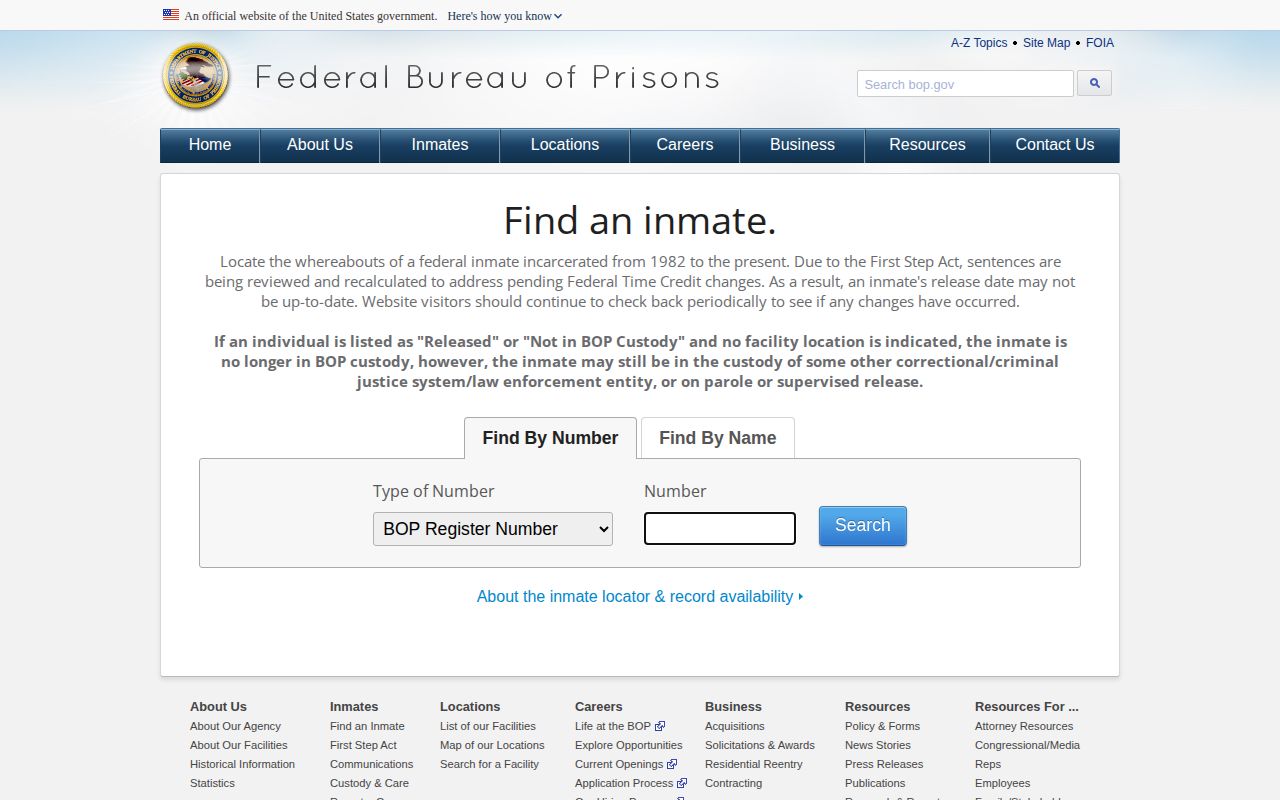
Read its result as a federal BOP status, then check any other agency that may have received custody.
Federal Release Record Contacts
For a sentenced person assigned to BOP, use the locator's institution information and BOP records channels. Identify the person by full name and federal register number. Ask for the specific existing record needed, such as designation, movement, or release information that is lawfully available. For a pretrial federal person, the federal court docket and counsel are often more useful because the Marshals Service, not BOP, may control placement.
Correct Federal Route
BOP Inmate Locator
bop.gov/inmateloc
Federal prison custody and release dates from 1982 forward
U.S. Marshals Service
Prisoner Operations
Federal pretrial custody context, without a public historical locator
Harvey County Detention Center
800 N. Main St., Newton, KS 67114
316-284-6959
Immediate local custody disposition
The U.S. Marshals Service does not provide a BOP-style public historical released-person search. It also says prisoner photographs, personal histories, and arrival or departure times are not released to the public. Use the federal docket for the legal order and the actual holding jail for immediate status. Use BOP only after commitment or other documented BOP inclusion.
BOP Locator Record Scope
The BOP database is broader than a list of convicted sentenced prisoners. BOP warns that records can include pretrial defendants, people whose charges were dismissed, material witnesses, and civil-contempt commitments. Finding a name therefore does not by itself prove conviction. Read the federal case disposition. Likewise, absence from BOP does not rule out federal pretrial custody under the Marshals Service.
For releases before 1982, archival research through the National Archives and Records Administration may be needed. Even for later records, identity data and old entries can require care. The federal register number is the best public key when known. Save the result date and wording, because locator data and projected dates can be revised.
BOP Release Date Meanings
A displayed future BOP release date is not a guarantee. Sentence credits, court action, administrative recalculation, or a change in custody can affect it. BOP has warned that First Step Act recalculations can temporarily make public dates inaccurate. Check the locator again near the date and look for a past date paired with “RELEASED” or no active facility before describing the event as completed.
A BOP past date documents departure from BOP on the system's terms. It does not state whether the person started supervised release, was taken on a state warrant, returned to a county jail, or entered ICE custody. The federal docket may show supervised release conditions or a later violation proceeding. A state or local jail record may show a detainer and transfer. ICE has its own locator. Complete the sentence in any notes: released from BOP, on the reported date, to the community or named authority if known.
Harvey Jail Federal Transfers
The Harvey County Housed Inmates list is a current county-jail interface. A federal person can disappear from it because the Marshals Service transported them, because another facility took custody, or because a court authorized community release. The roster disappearance cannot identify which outcome occurred. Call the Detention Center and ask for the release disposition or receiving agency, then check the federal docket.
If the person was committed to BOP, allow for designation and database timing. Search the BOP locator with the federal number. If the person remained in pretrial Marshals custody, there may be no BOP locator result even though federal detention continues. The Harvey County release search separates county, state, federal, and immigration paths so one system's no-result is not treated as universal proof.
Verify Federal Release Across Systems
Use the source closest to each fact. The local jail records physical departure from Harvey County custody. The federal court records the legal order and sentence. The Marshals Service manages many pretrial placements. BOP records federal prison status and its reported release date. ICE records covered civil immigration detention. None should be made to answer for all the others.
Kansas VINE is useful for an agency-fed Harvey County jail event, but it does not cover BOP prison custody. KASPER covers Kansas state corrections, not federal imprisonment. A person may move through two or more of these systems in sequence. Keep each timestamp and agency label in the notes. If dates conflict, request the originating record instead of choosing the most convenient online value.
Finally, release from federal prison does not erase the criminal case. The docket remains the source for judgment, sentence, and supervised-release terms. Locator data should be used to verify custody movement, reconnect with someone, follow a legal matter, or document an agency event, with the result checked against the federal record.
Build a Federal Release Timeline
A federal custody timeline should begin with the court case and then follow the responsible custodian. A federal arrest can lead to a detention hearing and Marshals Service control. Housing may occur in a local contract facility, which can place a federal person on a county roster. After conviction and commitment, BOP designates an institution. A later BOP release can begin supervised release or lead to another authority. The physical buildings may be in several states even when the case has a Harvey County connection.
Record each event with its source. Use the county booking record for arrival and departure from Harvey detention. Use docket entries for detention, judgment, sentence, release orders, and supervision proceedings. Use the BOP locator and BOP records for prison placement and the BOP-reported release. If a state warrant or immigration transfer follows, add that receiving record rather than extending the BOP label beyond its scope.
This sequence also resolves many apparent contradictions. A county roster can remove the name while Marshals custody continues. BOP may return no result before designation. Later, “RELEASED” can appear even though another agency holds the person. A future date can move after recalculation. The correct conclusion names the agency and stage, avoids assumptions during update gaps, and seeks the originating record when an exact time or destination remains unclear.
For a pre-1982 federal release, do not force the modern locator to answer a question outside its stated period. Use National Archives research and the federal court file instead. For a current record, preserve the register number and check date. If two people share a name, do not rely on the name alone. The public age and other returned fields should match before the release date is attached to the person.