
KDOC Release and Discharge Paths
No KDOC prison was identified inside Harvey County. The Kansas Department of Corrections entry represents a statewide network of prisons and community supervision, not a county building. A person sentenced in Harvey County may first appear at the county jail and later be transported wherever KDOC assigns them. That removal is a transfer to state custody. It is not a release into the community, even though the person drops off the county's Housed Inmates list.
Later movement out of prison may be parole, postrelease supervision, conditional release, or discharge. Parole is supervised community release under rules that apply to parole-eligible cases. Postrelease supervision is the mandatory community portion attached to many determinate Kansas sentences. Discharge is the clearer end of the KDOC sentence and supervision relationship. The court judgment and KDOC history should be read together, since the court establishes the sentence while KDOC administers custody and applicable release credits.
Confirm a Kansas Prison Release
Use KASPER, the Kansas Adult Supervised Population Electronic Repository. It covers the state correctional population rather than people whose only contact was a county-jail booking. Accept the public-use conditions, then search by full or partial name or KDOC number. Compare enough public identifiers to avoid selecting a namesake.
- Read the current facility, supervision, or discharge status.
- Review admission and movement history in chronological order.
- Separate the “Anticipated release date” from an actual movement or discharge entry.
- Compare the KDOC record with the Harvey County sentencing case.
- Request an official movement, release, discharge, or sentence-computation record if precision matters.
KASPER generally updates each working day rather than in real time. Its repository includes covered people who are incarcerated, supervised after incarceration, or discharged from Kansas sentences dating to 1980, subject to exclusions and lawful removal. That continuing coverage makes it more useful for a state-prison release than Harvey County's live jail list. It is not the right lookup for someone who bonded out locally and never entered KDOC custody. The Harvey County released inmate guide helps classify the last known agency first.
The official KASPER search screen provides the statewide name and KDOC-number routes.
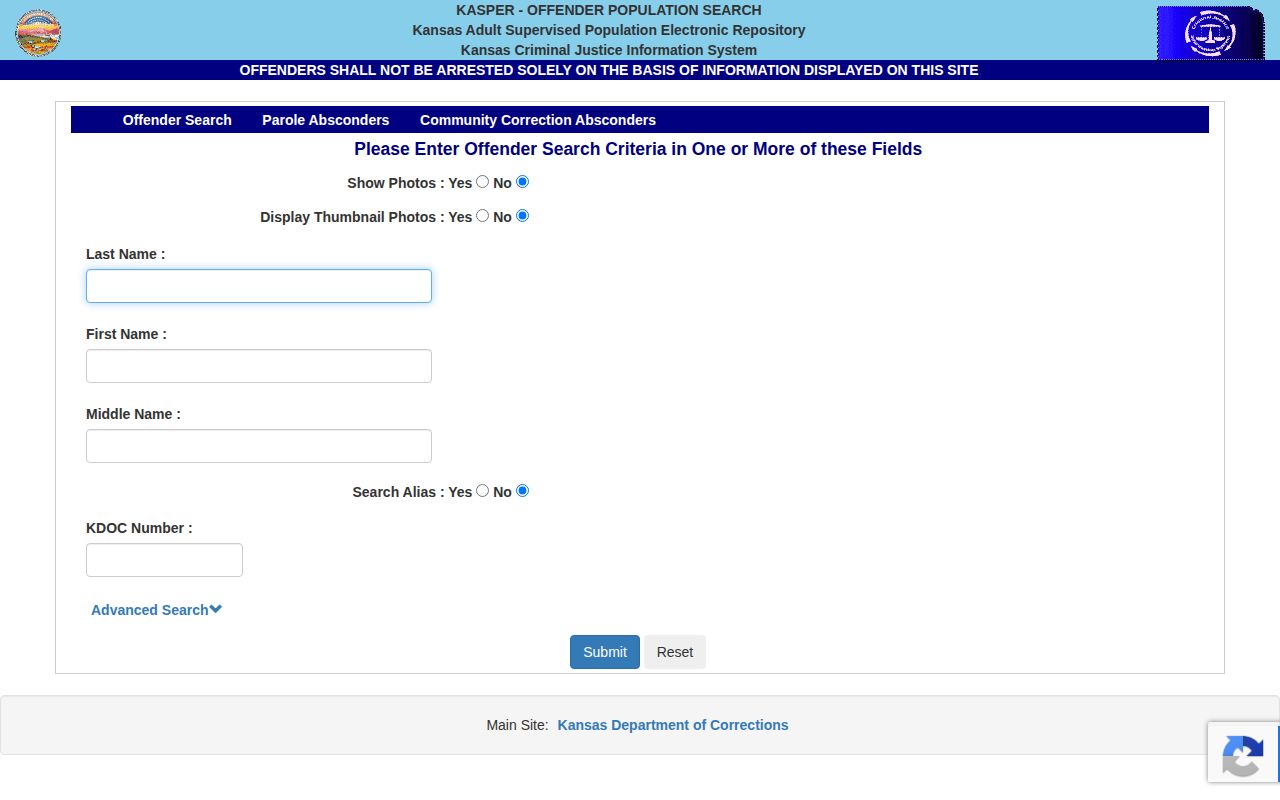
This is the correct public starting point after Kansas state-prison commitment, not a replacement for the Harvey County jail search.
KDOC Sentence Records Contact
When KASPER is incomplete or a date appears wrong, use the KDOC number to request existing admission, movement, release, discharge, or computation records. A screenshot only proves what the public interface displayed on the date captured. An official response or discharge certificate is stronger evidence of the legal event. Sentence Computation can help interpret or correct the calculation behind a date, but the public result should still be checked for a later actual movement.
Kansas Corrections Contacts
KDOC Sentence Computation Unit
785-296-3317
Sentence and anticipated-date questions
Hutchinson Parole Office
113 W. 1st St.
Hutchinson, KS 67501
620-669-0175
Harvey County parole and postrelease office routing
Prisoner Review Board
714 SW Jackson St., Suite 300
Topeka, KS 66603
785-746-7516
Ask for a defined record and date range. Include the person's name and KDOC number. If the question concerns an individual Board decision, request that record from the Board and then check KASPER after its next working-day update. The Board's public calendar and upcoming-offender list show possible action, not proof that parole was granted or that a gate release occurred.
Kansas Corrections Record Scope
A KASPER detail may contain the KDOC number, public descriptors, conviction and sentence information, facility or supervision status, admissions, movements, release-related dates, and an offender photograph. Exact fields vary by record and sentence era. KASPER also states exclusions. Juvenile records, certain custody categories, and information removed by law may not appear. A no-result does not prove the person has no Kansas record.
Community-corrections probation is not the same as KDOC parole. KASPER warns that community-corrections probation events after April 21, 2021 may not display because of system modernization. For a Harvey County probation case, contact Court Services or Harvey and McPherson Counties Community Corrections. For parole or mandatory postrelease tied to a KDOC prison sentence, the Hutchinson Parole Office is the local state supervision route.
KDOC Anticipated Release Dates
KDOC uses the exact label “Anticipated release date.” Treat it as calculated planning information. It can change as credits are earned, withheld, or forfeited. Jail credit, concurrent or consecutive sentences, amended court orders, disciplinary action, program credits, and statutory eligibility can also affect the calculation. A future date does not establish that the person has left prison.
For many crimes committed under modern Kansas sentencing rules, K.S.A. 21-6821 allows a general maximum good-time credit of 15 percent of the prison portion. That produces the familiar 85-percent shorthand only when the rule applies and all credit is retained. Qualifying lower-severity cases can have a 20-percent maximum, and eligible people may receive up to 120 days of designated program credit. Older, off-grid, and special sentence structures follow different rules. Do not reverse-engineer a firm date from a broad percentage.
After the anticipated date passes, look for the actual movement and current status. If the person moved to supervision, the correctional relationship continues. If KASPER reports discharge, the KDOC sentence relationship has ended, though a separate case or other lawful obligation may remain. See Release Date Lookup for the date-calculation distinctions.
Harvey KDOC Parole Decisions
The Kansas Prisoner Review Board handles parole-suitability functions and publishes monthly public-comment session materials. An upcoming list can include a name, KDOC number, county of offense, case number, offense, and a possible later release month. The county listed is the county of conviction, not a promised destination after release. A Harvey County entry does not mean the person will return to Harvey County.
Possible Board outcomes include parole, a continue for more information or deliberation, and a pass that denies parole for a period. No official standalone person-by-person public decisions search was identified. Obtain the individual decision from the Board, then verify the later status in KASPER. For routine determinate sentences, movement to mandatory postrelease generally is not the same discretionary parole-suitability process used in old-law or specified life and off-grid cases.
Harvey Transfers Into KDOC
A Harvey jail card can disappear after transport to state custody. Confirm the county booking disposition first, then allow for intake and working-day updates before relying on KASPER. The Ninth Judicial District sentencing journal entry explains the commitment and jail-time credit. KASPER then shows how KDOC received and administered that sentence.
Kansas VINE is not the state-prison lookup. Its Kansas coverage is for adults in participating county jails and expressly excludes people housed in KDOC prisons. Use VINE for the Harvey County custody event before transfer, then KASPER for state reception, prison placement, supervision, and discharge. The two systems can document consecutive parts of one person's path without contradicting each other.
State release labels must be completed with context: released from which institution, into what supervision status, on what recorded date, and confirmed by which state record. That method keeps a county transfer, prison release, and final correctional discharge from being collapsed into one vague event.
Reconcile Kansas Discharge Records
The court and KDOC records serve different roles. A Harvey County journal entry can show the conviction, sentence, jail-time credit, whether terms run together or one after another, and any later court amendment. KDOC applies that judgment within the correctional system. Its record can show admission, institutional moves, anticipated release information, a move into supervision, and eventual discharge. A difference between the two sources may reflect timing or administration rather than an error.
First confirm that both records concern the same person and case. Next compare the sentence date and KDOC admission. Check for later journal entries, credit changes, revocation, disciplinary loss, or other movements before questioning the public date. If the discrepancy remains, call Sentence Computation with the KDOC number and the exact field at issue. Ask the court clerk about the court document, not the corrections calculation. Correct information at its source before relying on it elsewhere.
KASPER public information can also be affected by legal removal and repository limits. A missing detail does not authorize a guess. Request the existing record that would answer the question and note any lawful withholding. When an actual discharge must be established, seek the discharge entry or certificate instead of inferring it from an old anticipated date. That discipline matters because release from prison to supervision and final discharge are not interchangeable endpoints.
Keep a dated copy of the public result when following an active transition. Since working-day updates can lag the real event, compare the record again after the expected movement and ask KDOC for confirmation if the status does not settle. A careful note should distinguish the date KDOC calculated, the date the person physically moved, and the date the public repository displayed the change.